
What It Means to be a PathBreaker
There comes a point in many healing journeys where you begin to realize that the life you have been living no longer fully belongs to you.
Maybe you have spent years being the dependable one. The strong one. The helper. The person others turn to when things fall apart.
Maybe you learned early that staying quiet kept the peace. That overachieving earned approval. That caring for everyone else made you valuable. That exhaustion was simply part of success.
For many BIPOC helpers, healers, and first-generation professionals, these roles do not develop randomly. They are often shaped by survival, cultural expectations, inherited patterns, and the pressure to carry more than we were ever meant to hold alone.
At some point, many of us begin asking deeper questions:
Who am I outside of what I do for others?
What parts of myself have I silenced in order to belong?
What would it look like to move through life with more honesty, alignment, and self-trust?
That is where the PathBreaker journey begins.
PathBreak Is Both a Declaration and an Invitation
At PathBreak Coaching & Consulting, we believe healing begins when we interrupt the patterns that no longer serve us.
To be a PathBreaker means choosing to move forward differently.
It means becoming willing to question inherited beliefs about worth, success, sacrifice, perfectionism, and responsibility.
It means recognizing that survival patterns may have protected you at one point while also acknowledging they may no longer align with the life you want to create.
Being a PathBreaker is not about becoming perfect. It is about becoming more honest with yourself.
More willing to:
set boundaries without guilt
speak up even when your voice shakes
rest without needing to earn it
honor your emotional needs
choose authenticity over performance
create a life rooted in alignment instead of constant survival
The path is not always easy, especially when you are the first in your family, community, or workplace to challenge what has always been expected.
But healing often begins the moment we stop asking ourselves to keep shrinking in order to stay comfortable for everyone else.
Learning to Accept My Role as the Disruptor
Part of creating PathBreak came from my own journey of learning to accept who I am and how I naturally move through the world.
For a long time, I felt tension around the fact that I often became the person willing to speak up, ask difficult questions, or challenge systems and dynamics that did not feel aligned. Even when I felt nervous, I found myself returning to authenticity and honesty because silence often felt more painful than discomfort.
I grew up surrounded by strong women who carried a great deal. Like many women, I learned how to be responsible, dependable, and emotionally aware from an early age. I also learned how easy it can be to lose yourself in roles centered around helping, achieving, and holding everything together.
Over time, I began to realize that part of my healing involved embracing the role of disruptor rather than fearing it.
Not disruption for the sake of conflict, but disruption rooted in truth, healing, and integrity.
The willingness to say:
this is not sustainable
this no longer feels aligned
I deserve rest too
I want something different for myself and future generations
Being a PathBreaker often means becoming comfortable with disappointing expectations that were never truly yours to carry in the first place.
It means learning that authenticity may feel unfamiliar before it feels freeing.
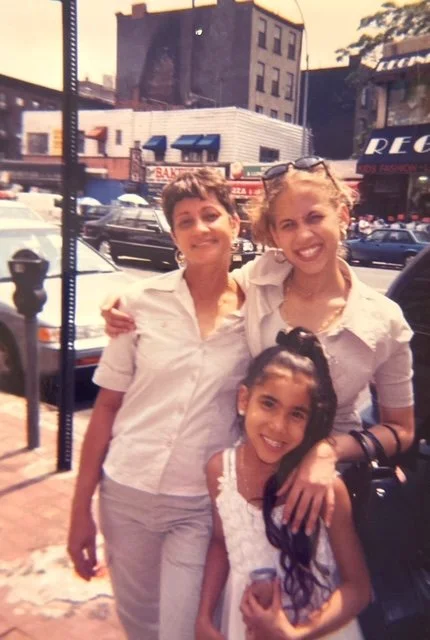
So much of my journey as a PathBreaker began with the women who taught me how to care, endure, and keep moving forward even through difficult seasons. Here I am with my mother and sister.
Healing Beyond Survival Mode
Many people spend years functioning in survival mode without realizing it.
Survival mode can look like:
constant productivity
emotional overfunctioning
hyper-independence
perfectionism
burnout
difficulty resting
guilt around boundaries
feeling responsible for everyone else’s wellbeing
From the outside, these patterns are often praised.
People may call you driven, selfless, resilient, or accomplished.
But internally, you may feel exhausted, disconnected, anxious, or unsure of who you are outside of constantly doing for others.
Healing asks us to slow down enough to notice those patterns with compassion rather than shame.
At PathBreak, we believe healing is not about abandoning ambition, leadership, or purpose. It is about reconnecting with those parts of yourself in ways that feel sustainable, intentional, and grounded in self-trust.
You Do Not Have to Navigate This Journey Alone
PathBreak was created as a healing-centered space for BIPOC helpers, healers, and PathBreakers who are learning to reconnect with themselves beyond burnout, overgiving, and inherited expectations.
Through reflective resources, emotional wellness tools, workshops, and community-centered learning, we support women who are ready to move beyond survival mode and create lives rooted in healing, alignment, and liberation.
Your healing matters.
Your voice deserves space.
And you do not have to walk this path alone.
Join the PathBreak Community
If this resonated with you, I invite you to join the PathBreak community for reflective newsletters, emotional wellness resources, workshops, and healing-centered support for BIPOC helpers, healers, and women navigating burnout, boundaries, self-trust, and purpose.
This community is for:
the women learning to rest without guilt
the helpers reconnecting with themselves beyond their roles
the cycle breakers choosing a more intentional path
the people learning that authenticity is safer than self-abandonment
You deserve support, too.